Showing posts with label art. Show all posts

Thursday, May 17, 2012

My Heart And My Flesh Cry Out

When the time for Pentecost was fulfilled, they were all in one place together... And suddenly there came from the sky a noise like a strong driving wind, and it filled the entire house in which they were.
- Acts 2:1

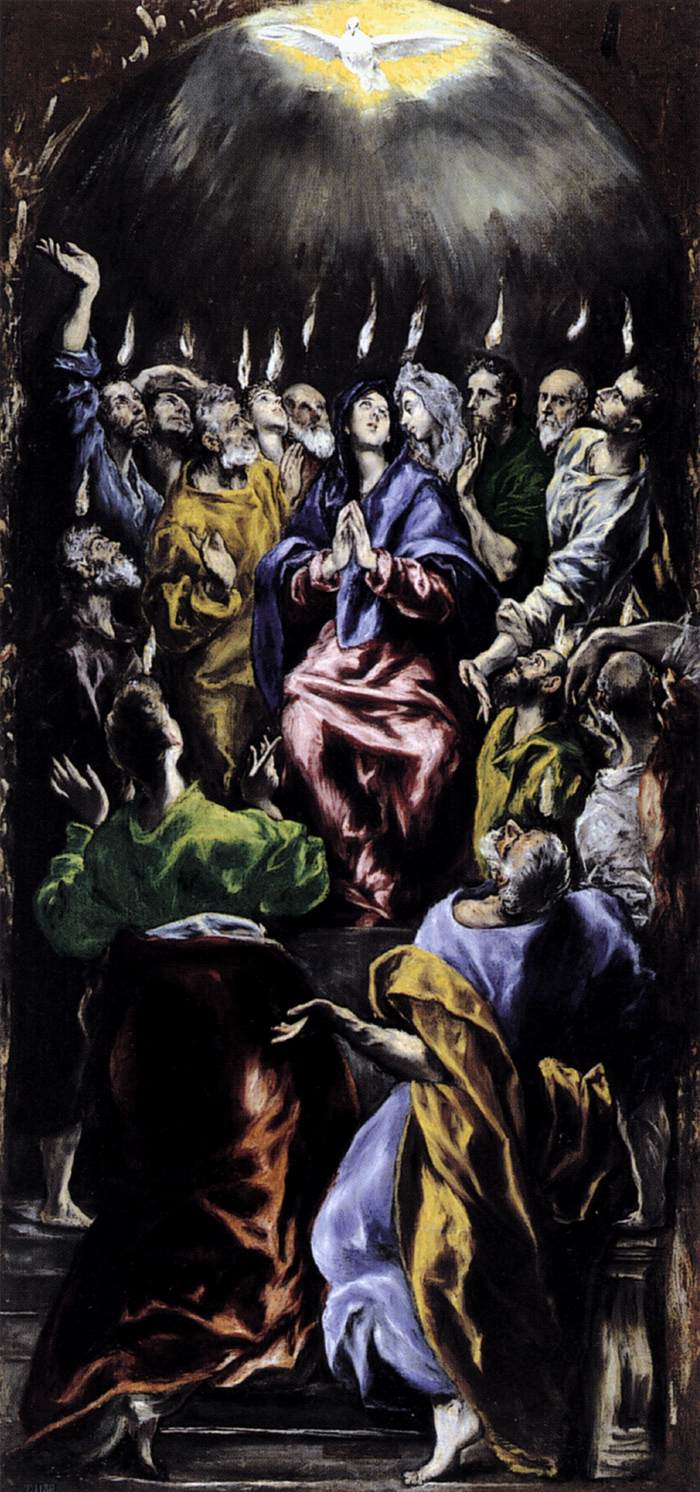
This is one of my favorite works by the painter affectionately known as El Greco, The Greek (Domenikos Theotokopoulos). Simply called “The Pentecost” it is an oil on canvas, painted in the 16th century and housed in the Museo del Prado, in Madrid. El Greco came to Italy just about the time Michelangelo was dying, and the Greek is famous, or infamous, for later criticizing the work of the world’s best known artist. In a wave of artistic prudery, Pope Pius V threatened to destroy Michelangelo’s Last Judgement, streaming as it is with naked bodies of the redeemed and the damned. (Let’s recall that a later pope, our beloved John Paul II, called the Sistine Chapel a “shrine to the theology of the body”!). El Greco supposedly claimed he could paint it over again if such a thing happened, and he would do it in a more Christian, appropriate manner. The painters of Italy apparently drove El Greco out for his arrogance, and he never set up shop in Rome again. 


Perhaps El Greco, painting in an almost iconic fashion in the Greek tradition, did err on the side of prudery, but his gifts still shine. His figures are “spiritualized” in a rapturous swirl, as if the Spirit has wooed them and coaxes them up and out of themselves. The Spirit calls them beyond themselves, into a field of infinite possibilities and adventures. Such is the attraction of the fire above their heads in this work, that they flutter upwards like moths to flame. We too would be swept up if not for the anchoring gaze of one of the Apostles, who eyes lock in on us, the viewers. We are left to wonder who it is... Thomas, Peter, one of the James's? In our contemplation this month, let’s allow this work to draw us up into the Spirit’s embrace, but recall this lesson of art history about El Greco and Michelangelo. We are to be humble, and to remember our vocation is not to become angels, pure spirits without bodies, as if the flesh is a weight that hinders the spirit. But we are called to be divinized, body-persons in whom the angels rejoice for the wonders of God written out in our flesh. 


For more on that glorious vision of the human body, see Michelangelo’s Sistine Chapel.


Wednesday, March 28, 2012

Everything is Holy Now

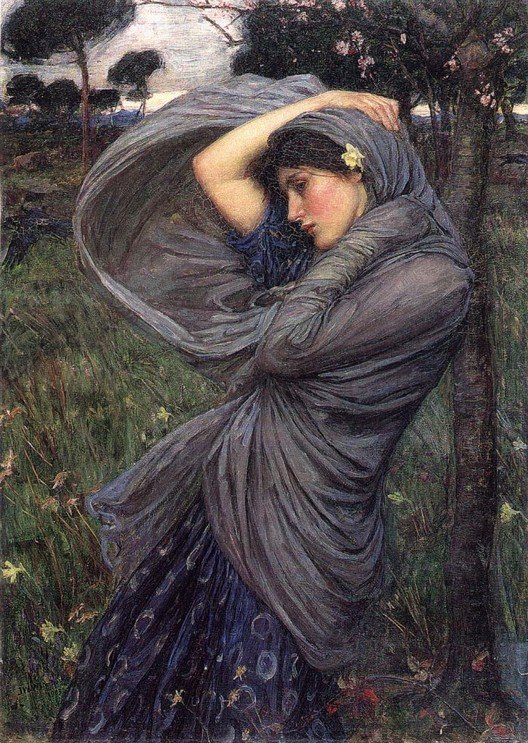
This painting by John David Waterhouse may not seem like "sacred art" at first glance. There are no angels, no bearded prophets, no sign or symbol of the Holy Spirit, the Virgin Mary, or Christ Himself. But look again.
"We are bid to color all things with hues of faith, to see a divine meaning in every event" wrote Blessed John Henry Newman. 
Since the Word became flesh, "every thing is holy now," sang the artist Peter Mayer. 
This image captivated me when I first saw it, as many images do from this school of painters known as the Pre-Raphaelites. It's called "Boreas," named for the Greek god of the north wind. But where is he? Look again. We see the evidence of his presence in the billowing folds of the young maiden's veil. We feel his weight leaning on the trees and the thick grass at her feet. He is literally everywhere, enveloping her, thick as the painted strokes on the canvas and at the same time just as fluid. 
Every ancient myth holds a glimmer of the gospel. The truth that God desires an intimate union with us has always shimmered along the thin webs of history, spanning the millennia and traversing all histories and cultures. Perhaps Boreas was a precursor of the Holy Spirit, coming in the warm breath of spring to the tender heart of Mary, initiating, offering, invigorating. 
Overshadowed by this Wind from Heaven, the woman covers herself. Perhaps she is awestruck, not by the force of the wind but by its chaste passion for her and its potential fruitfulness and life-changing power. Should she turn? Should she face that flow of power, open her heart and let Him fill her? Where will this wind take her should she open the sails of her soul to its power? We know the answer Mary gave and the path her life took. But when the Wind of the Spirit blows upon me, where will I turn? In what direction will I be taken?

_______________________________________
Originally written for the TOB Institute Newsletter

Wednesday, June 10, 2009

The Poet Michelangelo

I just stumbled on this moving passage from a poem (yes, he was a poet too) of Michelangelo's. Listen to the strain in his heart's voice as he looks beyond the veil of earthly life to what lies just where the horizon tips. Incredibly moving! The course of my long life hath reached at last, In fragile bark o'er a tempestuous sea, The common harbor, where must rendered be Account of all the actions of the past. The impassioned phantasy, that, vague and vast, Made art an idol and a king to me, Was an illusion, and but vanity Were the desires that lured me and harassed. The dreams of love, that were so sweet of yore, What are they now, when two deaths may be mine, - One sure, and one forecasting its alarms? Painting and sculpture satisfy no more The soul now turning to the Love Divine, That opened, to embrace us, on the cross its arms.

Thursday, June 26, 2008

Island of the World

A few months back, a friend recommended I read Michael D. O'Brien's novel Island of the World. Familiar with his work (Fr. Elijah and Strangers and Sojourners being my favorites from his Children of the Last Days series), I said "Sure, I'll have to pick that up." Little did I know it would take two hands to do so (it's 839 pages) and a good couple of months to finish it. Today, I read the last sentence, closed the cover, and am utterly and completely exhausted.

I feel like Frodo, lying in that soft bed of grass in Ithilien after his torturous trek through the pits of Mordor. In some ways, I'm reminded very much of the feelings that the Lord of the Rings stirred up in me at my first reading. It was a sweet melancholia, and in some ways I didn't want the tale to end. With Island of the World the pain was much sharper. It's realism pierced like a sword. Here was not a myth but a man, and I grew up with him, from the age of 8 or 9 until his late 70's, through love and sorrow, pain and poetry; the span of his life and experiences is massive and deeply moving. O'Brien's craft is growing more tender with the years. His characters seem to palpitate, their heartbeats pound right off of the page as they move through the world, taste and dance and sing and suffer. I suffered right along with them, and these wounds will be with me, I think, for some time. Reading this book was like open-heart surgery, and I didn't even realize I needed this operation! But the wound revealed is what St. John of the Cross called the Wound of Love. This book preaches without preaching our need for the tonic of forgiveness.

Wow.... I can't say more but to suggest committing to the work of reading this novel. And pack tissues... yeah, lots of 'em.... and you'll throw the thing down a couple of times too, by the way. It's crazy.... a crazy powerful tale of rapturous beauty rapt in frail mortality.

Peter Kreeft, one of my all time favorite authors had this to say about Island of the World.

"You will not want to put this book down until you finish it, and you will continue to live in it even after you close its covers. This story will change you. It will make you a wiser, better person. Is there any greater, rarer success we can hope for in a mere book than that?"
- Peter Kreeft, Ph.D., Boston College. Author, The Philosophy of Tolkien

Write up from O'Brien's website:
"Island of the World is the story of a child born in 1933 into the turbulent world of the Balkans and tracing his life into the third millennium. The central character is Josip Lasta, the son of an impoverished school teacher in a remote village high in the mountains of the Bosnian interior. As the novel begins, World War II is underway and the entire region of Yugoslavia is torn by conflicting factions: German and Italian occupying armies, and the rebel forces that resist them—the fascist Ustashe, Serb nationalist Chetniks, and Communist Partisans. As events gather momentum, hell breaks loose, and the young and the innocent are caught in the path of great evils. Their only remaining strength is their religious faith and their families... Ultimately this novel is about the crucifixion of a soul—and resurrection."
- from O'Brien's website

Sunday, April 13, 2008

Wasted in Wisconsin

In the Basilica Shrine of Our Lady Help of Christians (aka Holy Hill) there is a great deal of WASTE. It's scandalous really. A blatant disregard for the earth's resources! Marble vaults and pillars filled with angelic faces and Latin phrases, twists and turns in columns of precious wood and stone high above our heads, glass splintered into a thousand colors and hues in intricate webs of light. What were they thinking? And so much space! Dead air filled with nothing!

Well, nothing but music, and sunlight, and prayers in their heart-spun arc towards the tabernacle. And Love returning, burning and flowing from the altar.

Yes, what a terrible waste love is. What a slap in the face of utilitarianism and frugality. "The money could have been used to feed the poor," we can hear today's Judas' whining. But to waste, to pour out, to squander is the very nature of love.

The ones who built this Holy Hill, this Holy Temple, were kin to that woman of the gospels, who broke the alabaster flask of oil and "wasted" it, pouring it out onto the feet of Jesus. Thank God for her. Thank God for them. May we in our soulless strip malls, opaque office centers, and hollow gymnasium churches learn something from the extravagance of their love.

Friday, March 07, 2008

A World Away - Interview with Todd Smith on the New Series

My guest in this episode is Todd Smith, the new author of the Quest of Dan Clay series. He resides in the Rocky Mountain region of Colorado, and works for the Archdiocese of Denver.

"Thirteen years ago, William Clay - then a mere child - disappeared from a nearby forest, never to be seen again. Only recently, his younger brother, Dan, acquired information on the forest fables from a questionable source. After analyzing fact and legend, Dan suspects that his brother may have fallen through a portal into a parallel world and is being held captive. Join Dan and three friends as they embark on an out-of-this-world journey where they are hunted by savage beasts along the footpath to a demonic castle..... Smith’s pages within are your passport to A World Away, where the unimaginable becomes reality, the unnatural becomes the norm, and the uninvited become fitting prey. " - from www.TatePublishing.com

To buy the book, call 1-888-361-9473 or visit http://www.tatepublishing.com/bookstore/book.php?w=978-1-6024732-5-6
You may also visit amazon.com here.

The podcast of this interview is up and ready at this link.
Pope John Paul II's Letter to Artists can be found here.

Thursday, January 31, 2008

In the Spotlight

In the late 80's and early 90's, I was studying fine art at a community college; painting, drawing, sculpture and design. I loved it, and I often reflect on how I could just lose myself in an abstract watercolor or in the brushstrokes that leapt like flame from a canvas of sunflowers or a field of wheat by Van Gogh. It was always incredible to watch something come to life, so to speak, from my own paint-spattered or clay covered hands... to see it start to fill in and fill out of the void of a bleached canvas or a lump of clay.

I remember one project in particular; we were each commissioned to make a copy of the work of an old master. I chose a painting of Carravaggio's called The Lute Player. A great way to learn, in the way of art, music or for that matter the spiritual life, is to mimic the art of the masters, to trace the outlines of their marks and movements, and by habit to acquire some of their gift. We catch the sparks from the fire of their creative genius and carry it back to the kindling in our own souls.

As my work was coming along, I could see the hints and possibilities, a resemblance coming to light. After a week or so off, coming back to get my canvas from the art room closet where we stored them, I was "impressed" at my own work! Not too shabby, I thought. But that was cloaked in shadow. I pulled it from the dimly lit closet and out into the studio. Hmm....

Time away from things can clear the head and the heart, giving us a fresh look. I noticed some things needed serious reworking; brush hairs were stuck in certain spots, colors I thought had matched the original were a shade or three off. And those flesh tones... oiy. The guy looked sickly.

"The eyes of the LORD, ten thousand times brighter than the sun, observe every step a man takes and peer into hidden corners."
- Sirach 23:19

When I was young and new to the walk of faith, a line like this one from Sirach would, in layman's terms, "freak me out." This Master Painter wanted to be too close to us, it seemed to me. His Light was too bright. I had a sense of Him breathing down my back, my imperfections simmering their in the white-hot light of His Studio of Sanctity. I wondered if He really could see everything. Was the canvas of my heart and mind that open to Him? Could He see all the little smudges and mistakes, the haste and the waste I put down, sometimes merely out of obligation, just to get the grade? Sheesh... talk about pressure.

Today's Gospel from Mark 4 has Jesus speaking of this light, this blazing, penetrating beam of brightness that just will not leave us alone... “For there is nothing hidden except to be made visible; nothing is secret except to come to light. Anyone who has ears to hear ought to hear.”

Now I'm older. I look back and I see more clearly. I think there are two kinds of light. One is
man-made, like the light of flash bulbs from paparazzi; those annoying money-hungry celebrity photographers who are forever hovering over Hollywood and endlessly snapping shots of the famous and the vulnerable. And the other light is the light of God. It is claritas, lux mundi, the Morning Star and the Sun of Righteousness. The man-made light is merely a flash. It intrudes, grasps, glares, and exposes weakness for the sake of gossip, mockery, or transference. Or it beams on the beautiful for their moment in the sun, splashing a false light, a dream decoy to us in an effort to sell something.

God doesn't do that with His Light. His Light is simply reality. It is Truth.... and "in His Light we see Light." We see ourselves, the world, other people in the correct sense, and in the clarity of that Light, we let the Master's Hand enter in, touch the clay, shape the heart, move the brush and color the mind with the image of His Son.

Saturday, December 29, 2007

Good Talk and the Goal of Art

One of my favorite Christmas traditions, after a short night of sleep, staying up into the wee hours with my wife's family in NY state, nestled in that warm house in the cold, quiet of Montgomery, are my late morning talks with my father-in-law.

It's St. Stephen's Day, December 26, and like clockwork, I go for coffee and donuts (vanilla iced with sprinkles for the womenfolk) and make it back just as he stirs (the ladies won't be up for another hour). Then the talk begins, slow and rambling at first, like a rain stream. Then a clear path is cut by a strong river of serious thought, as we sip our coffee and look out on Eager Road.

Our topics string together like a strand of lights, the classic bulbs, big, bright, and heavy-laden. Then we sit back and watch the glow before the Christmas tree, from the couches in the living room. Our thoughts launch out and hover in the air - on music, books, theology, faith, the world as it is... as it was.... as it should be.

This morning we strayed into talk of classic films, Orson Welles, and Gregory Peck, Paul Scofield and their work. "When a person gives themselves so completely to their passion, be it art, film, etc., what happens to their heart? Can you lose yourself in a negative sense? Where does the personality go when you have not given yourself to another person, but to a performance?"

I mentioned a thought of Michelangelo's I had once read years ago: "Painting and sculpture can never satisfy the soul attuned to the Divine." It could be said for any of the arts.

We wondered about so many actors and actresses, musicians, and artists, brilliant in their work, whose personal lives often seem to be fractured. There is a sadness that often surfaces in their interviews and in talk shows. Is it because they have given their hearts away to a thing - a craft, cause, creation - before they even knew what their hearts were made for? I think we can lose ourselves in our own creations and in doing so forget the Creator. But what's the line, the distinction that must be made? Can both be done?

I remember sitting on the edge of a decision once, back in the early 90's. I was wrapping up my associates degree in visual arts. A choice had to be made: give myself to this art completely, or turn in the road, to who knows where?

I felt it in the heart, this choice. It was like standing on the edge of a precipice, feeling the rush of adrenaline. Feeling almost it seemed, hands willing to grasp my heart, and others waiting to hold it. That was a key distinction.

I chose to withdraw from that fall into the life of an artist, at least the life I was seeing lived by the contemporaries around me. Something seemed off. In the immortal words of Han Solo, I had "a really bad feeling" about it, as though living as an artist (in the secular mold) would have to mean living for art's sake alone. As though I'd lose myself to this amorphous "spirit of art" and the self would be forsaken. I had studied the modern masters and seen it myself... in Picasso, Van Gogh, Gauguin.

"Painting and sculpture can never satisfy the soul attuned to the Divine."

We so often trace the image, sketch the shadows cast by the Hand of God, and become enamored with it. But we're made for more. I think the total gift of self is meant for a Person, not a pop culture, or a "philosophy." The path to God (and to our truest selves) is indeed a path of self-giving. The leap of Jesus was the greatest self-emptying the world has ever known, but He did it for us, for men and women, for each individual heart that beats in the human race.

In his giving, Michelangelo gave us so much. In the moving, living, work and sweat of artists, poets, actors, and writers, we get great glimmers of truth and beauty. But we must never stop there. We've got to keep reaching out, yearning for that Face the reflection of which even now seems so overwhelming to our senses.

"Too late have I loved you, O Beauty of ancient days, yet ever new! Too late have I loved you! And behold, you were within, and I abroad, and there I searched for you; I was deformed, plunging amid those fair forms, which you had made. You were with me, but I was not with you. Things held me far from you - things which, if they were not in you, were not at all. You called, and shouted, and burst my deafness. You flashed and shone, and scattered my blindness. You breathed odors and I drew in breath - and I pant for you. I tasted, and I hunger and thirst. You touched me, and I burned for your peace."

- St. Augustine, Confessions

Wednesday, December 19, 2007

When You Gotta Go....

I was perusing through a closet for something the other day and found an old sketchbook of mine from art school. This is a cartoon I did around Christmas, circa 1990! I call it "When You Gotta Go, You Gotta Go."

I suppose it was a remnant of one of my deepest childhood questions on the plausibility of Santa and his ability to make it round the globe without a pit stop. Other thoughts considered the possibility of built-in plumbing on the sleigh, but I won't bore you with those blueprints...

Talking to Your Little Ones About the Big Topic of Sex

A much repeated sentence we hear at our Theology of the Body retreats and courses is "I wish I heard this when I was younger!" ...