
Sunday, January 27, 2013


Monday, October 08, 2012

Wednesday, September 19, 2012
The Raising of the Cross

The side panels show us the weeping women on the left, and on the right, Roman soldiers carrying out their duty. With the lens of the Theology of the Body, however, we see much more. The feminine panel glows with warmth, fragile beauty, and heartfelt concern. They are moved by the pathos of the Christ deeply. They receive it, feel it, internalize it. The masculine panel is bristling with raw energy, banners clap in a storm wind, sun and moon wrestle in the clouds as an apocalyptic eclipse ensues. But mirroring the outstretched hand of Michelangelo's Adam, who clearly influenced Rubens in this work, we see a man yearning, reaching out to touch that redemptive gift of the Christ as he is lifted up. We all must pine for him, for he is our peace! May all men and women appropriate this great gift of the Christ! And like the figures of Our Lady and St. John, situated on the "feminine" side, let us recall that, before the Lord, all our hearts are called to the feminine first. To receive, to take within, then to bring forth again in fruitful, faithful, self-giving love!
"And I, if I be lifted up from the earth, will draw all unto me." (John 12:32)
___________________________
Originally published for the Theology of the Body Institute newsletter, September 2012.
Tuesday, July 17, 2012
The Overwhelmed Parents Prayer for Peace

OK. Deep breath.... pray!
Oh Father, Son, Spirit, Three-fold Family from Whom all families are founded...
Help us this day to rejoice in the chaos that is our family. To enter intentionally into the endless mystery of the exhausting energy and tempestuous roller coaster ride of our children’s emotions, all raw and real; primordial mixtures of humanity and divinity, wonder and awe, awful and angry, tender and tactile as newborn bliss breaking into each moment with passion.
Let us abide in this place of grace, touched by greasy hands, constant calls, clinging and crying. For in this place You have placed us, Father and Mother, to mother and father, in patience and with peace, as much as we can gather.
For to You, we, father, mother, are as such, the same: crying, grasping, needing to be clean again; not wanting to be alone, to be filled, fed and led by You, Our Father Who is in Heaven.
So bless our family, these tired hearts and tiny hands, and help us all. Give us this day the daily bread of patience and peace, for this time shall pass, and these little ones and we will be weathered by greater storms than these, and grow wiser we pray, and they will need us, and we each other, even more than now. So we cling to You, Oh Sweet Father, Son, and Spirit of Love.
May we live and breathe and find our being in You, God of the Raw, and Reckless, Blindingly Beautiful Creator of the Universe. May we find You in these Gifts, in this Present, in these miracles, all. May we find Your Peace, not apart from this Holy Hurricane of family life, seeking outside a solitary shelter, but may we dance in the very Center of this Holy Communion of Persons, in the Eye of this Sanctifying Storm, this Holy Place, where saints may be formed, and the dross of our sin and weakness burned away, till only gold remains.
Thursday, May 17, 2012
My Heart And My Flesh Cry Out
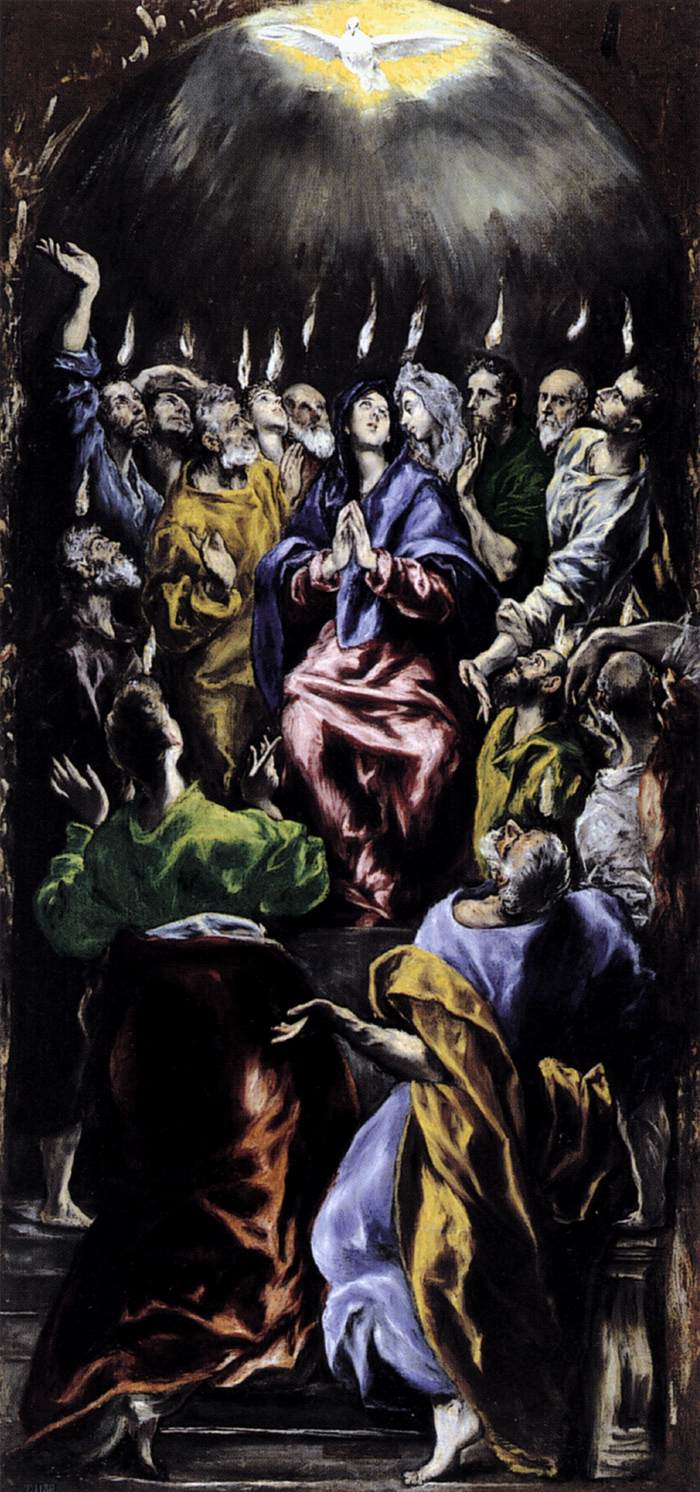
- Acts 2:1
This is one of my favorite works by the painter affectionately known as El Greco, The Greek (Domenikos Theotokopoulos). Simply called “The Pentecost” it is an oil on canvas, painted in the 16th century and housed in the Museo del Prado, in Madrid. El Greco came to Italy just about the time Michelangelo was dying, and the Greek is famous, or infamous, for later criticizing the work of the world’s best known artist. In a wave of artistic prudery, Pope Pius V threatened to destroy Michelangelo’s Last Judgement, streaming as it is with naked bodies of the redeemed and the damned. (Let’s recall that a later pope, our beloved John Paul II, called the Sistine Chapel a “shrine to the theology of the body”!). El Greco supposedly claimed he could paint it over again if such a thing happened, and he would do it in a more Christian, appropriate manner. The painters of Italy apparently drove El Greco out for his arrogance, and he never set up shop in Rome again.
Perhaps El Greco, painting in an almost iconic fashion in the Greek tradition, did err on the side of prudery, but his gifts still shine. His figures are “spiritualized” in a rapturous swirl, as if the Spirit has wooed them and coaxes them up and out of themselves. The Spirit calls them beyond themselves, into a field of infinite possibilities and adventures. Such is the attraction of the fire above their heads in this work, that they flutter upwards like moths to flame. We too would be swept up if not for the anchoring gaze of one of the Apostles, who eyes lock in on us, the viewers. We are left to wonder who it is... Thomas, Peter, one of the James's? In our contemplation this month, let’s allow this work to draw us up into the Spirit’s embrace, but recall this lesson of art history about El Greco and Michelangelo. We are to be humble, and to remember our vocation is not to become angels, pure spirits without bodies, as if the flesh is a weight that hinders the spirit. But we are called to be divinized, body-persons in whom the angels rejoice for the wonders of God written out in our flesh.
For more on that glorious vision of the human body, see Michelangelo’s Sistine Chapel.
This is one of my favorite works by the painter affectionately known as El Greco, The Greek (Domenikos Theotokopoulos). Simply called “The Pentecost” it is an oil on canvas, painted in the 16th century and housed in the Museo del Prado, in Madrid. El Greco came to Italy just about the time Michelangelo was dying, and the Greek is famous, or infamous, for later criticizing the work of the world’s best known artist. In a wave of artistic prudery, Pope Pius V threatened to destroy Michelangelo’s Last Judgement, streaming as it is with naked bodies of the redeemed and the damned. (Let’s recall that a later pope, our beloved John Paul II, called the Sistine Chapel a “shrine to the theology of the body”!). El Greco supposedly claimed he could paint it over again if such a thing happened, and he would do it in a more Christian, appropriate manner. The painters of Italy apparently drove El Greco out for his arrogance, and he never set up shop in Rome again.
Perhaps El Greco, painting in an almost iconic fashion in the Greek tradition, did err on the side of prudery, but his gifts still shine. His figures are “spiritualized” in a rapturous swirl, as if the Spirit has wooed them and coaxes them up and out of themselves. The Spirit calls them beyond themselves, into a field of infinite possibilities and adventures. Such is the attraction of the fire above their heads in this work, that they flutter upwards like moths to flame. We too would be swept up if not for the anchoring gaze of one of the Apostles, who eyes lock in on us, the viewers. We are left to wonder who it is... Thomas, Peter, one of the James's? In our contemplation this month, let’s allow this work to draw us up into the Spirit’s embrace, but recall this lesson of art history about El Greco and Michelangelo. We are to be humble, and to remember our vocation is not to become angels, pure spirits without bodies, as if the flesh is a weight that hinders the spirit. But we are called to be divinized, body-persons in whom the angels rejoice for the wonders of God written out in our flesh.
For more on that glorious vision of the human body, see Michelangelo’s Sistine Chapel.
Monday, April 23, 2012
Mexico, Volcanos, and the Scope of Human Love

The Theology of the Body holds within it the full truth and meaning of sexuality and therefore conjugal and consecrated love. After all, it is a reflection rooted in Scripture offered by a celibate man and priest of God, Pope John Paul II, grounded in his prayerful dialogue with those celibate, married or aspiring to marriage over the course of his entire life. It is an understanding of human love in the Divine plan; in other words, it is Christianity reloaded, and reincarnated for the modern world. It's not something new, as much as it's something renewed for modern man. In essence, it addresses the human ache for the infinite, and in this regard can speak volumes to the hearts of every man and woman on the planet; single, married, celibate, widowed, divorced, disenchanted and dysfunctional (which is actually all of us).
Fr. Cantalamessa once wrote... "The primary object of our eros, of our search, desire, attraction, passion must be Christ."
The God-given desire for intimacy, expressed so beautifully in the marital embrace is really a kind of foreshadowing of a Love that will and already can fill every hole in the heart. Ask any married person and in all honesty they should answer you that their spouse isn't their savior. We really can't, in our fallenness and imperfection, fully "complete each other." We must look for a Higher Love, one that can flood every human vessel with Divine Mercy. A Love which can lead us up and out of ourselves, through others to the Source of all Love. Think how often human couples speak of "falling in love" as if it actually is a separate reality, distinct from the two of them. And marital love not only can create a third person, but it truly IS the presence of a Third Person. Love is the Holy Spirit, Eternal Bond of the Father and the Son! Love is truly a Trinity. And the Catechism again reveals to us this connection of the human to the Divine: God has revealed his innermost secret: God himself is an eternal exchange of love, Father, Son and Holy Spirit, and he has destined us to share in that exchange. - CCC, 221
In Mexico, we pondered these truths, in a beautiful retreat center, nestled in a mountainous gap between two massive volcanos. One was aptly named for a warrior (still actively spewing plumes of ash like a smokey sword into the sky) and the other called the "Sleeping Maiden" - the warrior's treasured beloved, a reclining snow-covered range of mountain peaks. In their shadows, we pondered the significance of masculinity and femininity in the world. We saw just as the ancient indigenous of the region did in those mountains, something cosmic in man and woman, something that earthly signs were here to point towards. In our separate and distinct vocations, we taught each other and learned from each other. I prayed that my marriage witnessed the tenderness and service needed to make love present in the family. And for me, I learned from these beautiful, consecrated spouses of Christ, that my married love must open itself to the tenderness and service poured out in the Sacred Heart of Jesus.
Such is the sweet complimentarity of the calls to conjugal and consecrated love. One day when the Spirit comes to flood the world again and return us all to the Father, we shall all be wrapped up in that heavenly embrace where "totality embraces totality." (Pope Benedict XVI) And in Heaven it is said that all men and women will "rejoice one day with your Beloved, in a happiness and rapture that can never end." (St. Teresa of Avila)
Tuesday, April 17, 2012
The Mystical Body Of Christ: Sacred Art and the Theology of the Body

The Apostles appear around him as if in adoration, cloaked in glimmering robes, heads bowed. The bread and wine appear set in a triangular formation, pointing off center to the place where Christ’s side will be pierced by a soldier’s lance. Above and embracing the entire scene is another body, massive, encompassing the whole celebration. This is the feast of the Body of Christ, and the Theology of His Body has become, to the utter amazement of the cloaked men around Him, the gateway to Infinity. Wrapped in contemplation, we can imagine them, like us, pondering this mystery. Jesus’s very chest is now translucent; it has become a portal allowing us access to the Father! Dali has the enigmatic symbol of this journey of faith well represented; a boat appears waiting for us, behind or perhaps through the Heart of Christ.
In this holy season, this Easter season now dawning in the month of April, we are invited to see with this new light. A divine and diaphanous light has now penetrated and permeated into the cracks and dark spaces of each and every human experience. If we choose to turn our faces towards Him, open these spaces before Him, He will fill us up with that same light. Let us heed the words of Blessed John Paul II:
“To contemplate the face of Christ, and to contemplate it with Mary, is the “program” which I have set before the Church at the dawn of the third millennium, summoning her to put out into the deep on the sea of history with the enthusiasm of the new evangelization.” - Ecclesia de Eucharistia, #6
And in this post-resurrection feast of love and light, in the breaking of this bread, we will truly see “each other, as if through the mystery of creation, man and woman see each other even more fully and distinctly than through the sense of sight itself...” (Blessed John Paul II, TOB, Jan. 2, 1980)
_________________________________________________________________
Originally published for the Theology of the Body Institute April 2012 newsletter.
Subscribe to:
Posts (Atom)
Talking to Your Little Ones About the Big Topic of Sex
A much repeated sentence we hear at our Theology of the Body retreats and courses is "I wish I heard this when I was younger!" ...

-
 In Tolkien's mythology of Middle-Earth, he writes of a time before the downfall of humanity, when the world was flat. The Valar, angelic...
 -
OK. This image is a little creepy. But I didn't make it up. I'm going to meet it this weekend, "face to face." Uh.... Let ...
-
 If they knew how big they’d become on the music scene, lead singer Ben Gibbard of the band “Death Cab for Cutie” once confessed, they woul...
