Thursday, March 12, 2015

LUCY and the Longing of the Heart for More


I was a young boy in the 1970’s and 80’s, coming of age in the early days of the movie magic of Steven Spielberg and George Lucas; of galaxies far, far away, of Close Encounters, and hidden mysteries, of Lost Arks and great adventures. I can honestly say my formation and invitation into wonder and transcendence was assisted, however imperfectly, by the films of my youth. St. John Paul II once wrote in 1998 that movies are "the mirror of the human soul in its constant search for God, often unknowingly. With special effects and remarkable images, it can explore the human universe in depth. It is able to depict life and its mystery in images. And when it reaches the heights of poetry, unifying and harmonizing various art forms — from literature to scenic portrayal, to music and acting — it can become a source of inner wonder and profound meditation." I love movies! And I love St. John Paul II.

But let's be honest, as much as a film can form, or even transform the viewer, so it can also deform. There are the obvious movies that are simply full of explosions or exploitations of the beauty of human sexuality (or both). These films cheapen the human person, leaving their darkened images to cloud our thoughts like gnats incessantly buzzing about, and those images aren’t easily brushed away. But there are also the more subtle scripts whose ideas not only carry an impure vision of the human person but a deeply twisted one. With that in mind, let’s look at the recent release of the Scarlett Johansson, Morgan Freeman movie “LUCY."

It’s premise is one I've always been fascinated by; accessing the full potential of the human brain. It’s an idea present in movies like the 1995 Sean Patrick Flanery sleeper “Powder”, the 1996 John Travolta film "Phenomenon", the more recent piece starring Robert De Niro and Bradley Cooper called "Limitless” (2011), and in a more tangential way, last year’s “Transcendence” starring Johnny Depp. I’m fascinated with the idea because the speculative theologian in me has always imagined that the “unused” 90% of our brains might be due to the Fall in Eden. We’ve been promised that the full potential of the human person will be unlocked for us in Heaven. Perhaps there we’ll enjoy the full spectrum of light and of sound, of the deep knowledge of the physical universe and of a thousand other gifts that God wanted preternatural man to have in imaging His own beauty? After all, St. Irenaeus wrote “The glory of God is man fully alive.” LUCY, however, sees a far more impersonal eschaton. Prepare yourself for spoiler alerts.

Against her will, Lucy becomes a “drug mule" who transports a highly unstable new drug that can unlock the brain’s potential. Through a series of painful encounters, the pouch within her is punctured and the drug released into her blood stream. Lucy then frees herself from her captors and begins a whirlwind ride as her “unused” brain matter is exponentially actualized, even as her captors are in hot pursuit of their “stolen” goods. 

There are plenty of explosions, narrow escapes, speculative science jargon and even touching moments to make this film engaging. I was moved the most by Lucy’s phone call to her mother. Her brain power is climbing, 20%, 30%, 40%, as she sees her life and health (due to the drug) unravelling, she reveals a “knowledge” that no one before could possibly access, and it's done so tenderly. "Mom? … I feel everything... The heat leaving my body. The blood in my veins… The pain in my mouth when I had braces. I… I can remember the feeling of your hand on my forehead when I ran a fever… I remember the taste of your milk in my mouth. The room, the liquid... I just want to tell you that I love you, mom, and dad… I want to thank you for the thousand kisses that I can still feel on my face. I love you, Mom."

This for me was a climactic moment in LUCY. It revealed a fullness of humanity in the dimension of relationship. This is ultimately why we are here; for communion! In his first encyclical, Lumen Fidei, Pope Francis wrote that “the core of all being, the inmost secret of all reality, is the divine communion.” (Lumen Fidei, 45) Human love here below is the gateway, the primer, the first steps we take to enter that communion!

But alas, the materialistic philosophy of the writers of LUCY stops short of such sublime communion. Instead, the more Lucy’s brain matter is actualized, the less human she becomes. Her communion is only with matter, not spirit, not the depth of other people or of the Divine, but only their DNA. She knows every atom, but she doesn’t know Adam. Lucy becomes increasingly stoic, vapid, almost as expressionless as a computer screen. In the end, this is exactly what she becomes; a disembodied cloud of consciousness who can “access” everything and yet touch no one. As Lucy sees herself slipping away she kisses a police officer, telling him she does this so she “won’t forget.” As a last ditch act of selfless heroism, we see Lucy wanting to give all of the “information" her brain has tapped into for the benefit of science. To take on this noble task, there is the ever popular Morgan Freeman, playing the role of Professor Norman. The dehumanizing philosophy of the LUCY film than reveals itself in a dialogue between them:

Lucy: "I don't feel pain. Fear. Desire. It's like all things that make us human are fading away. It's like the less human I feel... all this knowledge about everything; quantum physics, applied mathematics, the infinite capacity of a cell's nucleus. They're all exploding inside my brain, all this knowledge. I don't know what to do with it."

Professor Norman: "You know… if you think about the very nature of life. I mean, from the very beginning. The development of the first cell divided into two cells. This whole purpose of life has been to pass on what was learned. There is no higher purpose. So, if you're asking me what to do with all this knowledge you're accumulating, I'd say, pass it on. Just like any simple cell going through time."

No higher purpose? Aquinas once posited the question of the hierarchy of knowledge over love. He reasoned that the knowledge of a thing gave us a power over it; hypothetically our knowledge could give us a power over the whole universe. But love, he saw, was our greatest “power." Love is that true evolution that is, as Chesterton wrote, a revolution. It allows us, not to possess, but to be possessed. Pope Benedict once wrote that "Love is the very process of passing over, of transformation, of stepping outside the limitations of fallen humanity... into an infinite otherness."

Our perennial lust for material knowledge can never satisfy the human longing for intimacy, the kind of knowledge that is in fact deeply spiritual. This contemporary craving for a disembodied life detached from the “limitations” of our earthly existence, is in reality a fear; a fear of love. Perhaps a fear of our own fragile humanity. But what appears to be weakness or a limitation is in fact our greatest gift; just think of the naked, crucified Christ, who is perfect love poured out for each of us! Films like LUCY and philosophies like that of the transhumanists posit the idea that we are deeply flawed in our bodies; that our “biological package” needs an upgrade. The transhumanist website humanityplus.org envisions a world that affords us "the continuation and acceleration of the evolution of intelligent life beyond its currently human form and human limitations by means of science and technology…" (Max More 1990, www.humanityplus.org) But the path to true human flourishing, and the full actualization of the human mind must never be at the expense of the heart, or of the integrity of the whole human person. These ideas show us a twisted hunger for the kind of fuller knowledge that once shimmered in Eden, when the first man and woman could "see each other even more fully and distinctly than through the sense of sight itself... they see and know each other with all the peace of the interior gaze.” (St. John Paul II, TOB 13:1) This is the knowledge that leads to love, which is the “innate and fundamental vocation of every human being.” (St. John Paul II, Familiars Consortio, 11)

May we who have been given the beautiful integrated vision of the human person in John Paul II’s Theology of the Body shine a light on this ache for true knowledge, and lead modern man and woman back home to themselves. 

Lucy: "I want to thank you for the thousand kisses that I can still feel on my face. I love you, Mom."
Lucy's Mother: "I love you too, sweetie. More than anything in the world."


Tuesday, February 24, 2015

GUEST POST: A Woman's View of 50 Shades of Grey

On 50 Shades of Grey
By: T Nicole Cirone Wilkinson


I've been thinking a lot about the 50 Shades of Grey issues ever since the book came out in 2012. People started buying it up—the more “prudish” reading it on Kindles so as to obscure the cover, and the brazen ones flaunting it on the beach and the subway; book clubs all over the country featured it as their choice of discussion material (even on the heels of the likes of Reading Lolita in Tehran), and the phrase “mommy porn” was used to describe the controversial book.  Now with the release of the movie (just in time for Valentine’s Day!), I have the same reaction that I had three years ago, when the book, whose storyline turns around what used to be a taboo, marginalized sex fetish, a “whips and chains” obsession of fringey weirdos, suddenly took mainstream culture by storm: WHY?

My first reaction to reading the (TERRIBLY written) book, which I read to see what all the fuss was about was, "this isn’t sex—this is abuse!" It's not just power and powerlessness, but abuse and torture that's being softened and packaged to women as something not just acceptable, but desirable-- something we should expose our most precious and vulnerable selves to in the name of pleasure. What the heck?

I know the whole fetish community and the people who practice BDSM have been around a long time. And it’s not the first time it’s made its appearance in mainstream or popular culture.  Those of you who are around my age (40something) may remember in the 90s when mainstream fashion adopted the multi-strap "Dominatrix"-style dress and high boots. The look was "supposed" to be "sexy" and "dangerous"-- but we just kind of wore it and didn't think twice that it looked like we were tied up in those dresses and bound in those shoes because, I think, it wasn't thrown in our faces as something we regular people should/could/might consider a legitimate sexual turn-on. It was “just fashion.” Maybe as a feminist, one could study those clothes in the 90s and say, well, they corresponded to a moment when women were actually gaining a lot of power in the workforce and the world as decisionmakers and policymakers, and the fashion industry (run by men, both gay and straight) wanted to rein them in in some way, making them dress in chokers and strappy black garments. But that’s a reach for the general population who just liked the thought of wearing 10 black straps and stiletto knee-high boots and didn’t think about being bound and whipped because they were wearing a choker (come on, I know some of you out there wore black ribbon chokers—did you want to be tied up and beaten during sex?). In fact, speaking of the 90s, I remember people used to use “S and M” terminology to describe people who unnecessarily brought pain upon themselves (why are you working so much—are you some kind of a sadist?) or mean people (don’t tolerate that masochistic boss who makes you work 15 hours a day!).

So now, with the 50 Shades series and movie and this whole "mommy porn," mainstream accessibility to what used to be a sort of sick view and practice of sex and sexuality, I am personally horrified.  Why aren’t more of us speaking out? Aren’t you angry? Here’s why I refuse to see the film and why I think more figures with a little influence in society need to get angry and speak up. 
Women have fought for centuries, millennia, not only to be recognized in society, but to be treated with respect. Throughout history, women who were held captive as sex slaves, forced to be confined in palaces, sold as property or forced to work as prostitutes are the most extreme examples of what we have fought against, but also, women who wrote poetry or wanted to be healers or who wanted a say in whom they would marry or a say in the law of their land, or in what jurisdiction we have over our own livelihoods and bodies and sexuality, or those of us who just wanted to be able to go to work and use our gifts without harassment from the men in the office, or from families, who may have encouraged marriage over education, have all been held captive in some way, victimized and bullied and sometimes even abused by a male-dominated society. And society’s norms have embraced this gender dynamic because when people are put in specific boxes, the powerful aren’t threatened when they have control over the powerless. In the past century, women have finally fought our way into society, and now I feel that mostly, we are beginning to be able to look at gender relations as less of a power play and more of a give and take-- women have fought for and taken opportunities to do amazing things in the world—with the freedom to choose their path in life, and in many developed countries, they have a say politics and business and a right to education. 

Furthermore, the international community has frequently rallied behind women who are still tortured in the form of sex trafficking and FGM; many individuals, governments and organizations have begun to address the inequalities that still exist in the world (though of course, there is still work to do) and most of our community and world leaders have said no to torture and abuse and sexual power dynamics. 

And finally...finally, it seems the beauty and power and gifts women have to offer (in addition to—and in some cases, especially childbearing) are recognized and honored in the developed world, and in the developing world, women are still fighting to get there because they know they don't deserve to be beaten down (physically or otherwise). They are not the second-class beings.

SO...this is one reason why 50 Shades and the mainstream complacency over not just the popularity of the book or the release of the movie—but the availability of bondage-themed sex “toys” in TARGET, of all places, disturbs me. Because after all of this...our society-- and WOMEN in our society-- embrace a book and film that tells us we don't really want to be in control of our bodies, ourselves and our lives. . What we really want as women is to be controlled and dominated-- not just in the bedroom, but in all aspects of our life, because being a thinking woman or an independent woman in the modern world is “too hard” and it’s “against our nature.”  Those of you who are familiar with the book will recall that in addition to his particular interests in the bedroom, Christian Grey is a control freak who doesn’t want to be vulnerable—so he won’t allow himself to be touched, and he starts controlling her entire life, down to the clothes she wears and the details of her life, and Anastasia is no longer her educated, intelligent self. In fact, she is consumed by his demands. And she feels “special” because he lavishes his attention on her—maybe the same way women will gravitate toward the “bad boy” and feel special when they win the guy over. There’s a bizarre sense of power tied up in that (pun intended).  

Sexual domination and abuse packaged in a way that makes BDSM seem sexy and desirable because it's "taboo" and "dangerous" is, I think, enticing for a lot of women who have not realized their own beauty or power because they feel they are "just a mom" or they are married to men who have given up on the relationship (because, in my humble opinion, of the ready availability of cheap, quick porn and standards of "beauty" that NO real woman could ever aspire to). Perhaps the way 50 Shades is packaged is supposed to appeal to the woman who "really" wants to be dominated by a man because she doesn't know what to do with herself in society-- the pressure of "thinking" and "performing" in a "man's world" is too much-- so naturally, she wants a man to put her in her place, to dominate and hurt her, and this is supposed to be a fantasy for all of us who have fought so hard to get out of the possibility of domestic violence or degradation or trapped in marriages we never wanted but were arranged by our fathers and husbands. The fantasy or escape aspect is supposed to be exciting to people who have been told all their lives to play by the rules and keep things safe. I suppose the book allows women to escape to this place, where things would probably never happen to them, but vicariously, they can experience the attraction to danger. But it is, in fact, danger, and pain—not beauty and intimacy-- so if what women “want” is to feel pain and danger during sex, how, then, can we know rape is absolutely wrong but see a “gray (grey) area” in sexual domination that uses force and pain to bring “pleasure”—and, worse yet, put it out there to mass market consumers? Is this acceptable because Christian Grey shows some concern for her and asks her if she’s ok once in a while? 

Grey’s dangerous "red room of pain" gives women who are desperate to feel a vicarious way to experience sensation-- even if it's imagined pain-- because they have lost sight of their own power.  And we as a culture have lost sight of the intimacy of sex and have made it a game, a sport, a pursuit-- and not just for men. "Everyone" has casual sex, and the Friday and Saturday night Tinder booty call is alive and well in bars all over the country (yes, some single people use this app to meet people -- but I recently read that married people use it "just for fun"-- as a drinking game and a way to “safely window shop”).

So what is the solution? I think maybe a little more vocal outpouring from religious organizations about the beauty of women's strength will help. For people who aren't religious, I think more groups-- not just feminists (because people will say, oh, it's those feminists again) need to address this.  Why is Hollywood making this movie? It's going to make money because people are going to pay to see it. Where are the female actors who have used awards ceremonies as a podium for advocating women’s voices and women’s rights now? Why are they not speaking out against the message this book/movie sends? And my biggest fear-- has our mainstream culture become so numb to this that we really aren't horrified?

If a woman was taken hostage by someone and bound and whipped and made to believe that she liked it, we would respond with outrage. Why are we supposed to be watching this for entertainment? We are no better than countries in which women are stoned in public, then, for sexual misconduct, or kept under lock and key. We are embracing that which we despise. In Canto III of Dante’s Inferno, he describes the souls in hell in this manner:  “their dread turns wish; they yearn for what they fear”—and then Dante is so frightened and horrified by this that he faints. 

In our wonderful country, we have the freedom to say what we want, to write what we want, to read what we want, to view what we want. And the erotica genre has been around a long time. Anais Nin and Henry Miller were both writers of erotica, and their books were banned for scatological passages. I am not suggesting we go on a censorship tear; rather, I think the accessibility and easy acceptance of BDSM as mainstream entertainment is symptomatic of other forces at work. This is about love and sex and the beauty of sexuality, which is being lost. It’s also about gender politics. It fundamentally cuts women-- and men-- to the core, and just because it’s out there and “softly” packaged so that it’s mainstream culture-friendly instead of on a fetish porn site or an adult store doesn’t mean we have to support it. Financial support is our greatest tool as a free-market culture. Without demand, the supply dwindles. What if we could raise enough awareness and make enough noise that we could prevent more of this sort of material from dominating mainstream culture (or at least keep it out of family-oriented stores like Target, for heaven’s sake!)? 

And if we really want to be bold… what if we looked at our culture and, even in our own lives, tried to make a small difference in uplifting both men and women, by fighting against not only the most blatant abuse and domination and sexual politics but also the micro-aggressions that slowly chip away at the self-worth and sense of beauty of those around us? Would 50 Shades be so entertaining then?  

______________________________________________

T Nicole Cirone Wilkinson has a BA in Political Science 
and Italian Studies from Rosemont College, an MA in 
English Literature from Rosemont College and an MFA 
in Creative Writing from Fairleigh Dickinson University. 
She is a published poet and writer and teaches English 
at Malvern Preparatory School.

Thursday, February 19, 2015

FIFTY SHADES OF GREY AND THE LIGHT OF TRUTH

I’m sure anyone reading this has already seen Fifty Shades of Grey to the point of saturation; a myriad of images, quotes, stats and rants on their Facebook and Twitter feeds about the “groundbreaking" film that has put sex toys in Target department stores (true story). In case you haven’t heard, it's the tale of a dominating billionaire who seeks to obsessively own a college student, luring her into his sadomasochistic world where her pain brings him sexual pleasure. It opens not on the eve of Halloween as you might expect, but Valentine's Day. Yes, Fifty Shades of Grey is being painted as a love story. However, the dominant color on its palette is still grey.  I don't want to talk about the movie anymore. I don't want to dwell in that murky grey any longer than we have to for the purposes of this piece. I want to make a heartfelt appeal to you all as men and women, first to my dear sisters, then my brothers, about what might be the reason this story has become so popular and how, I hope, a greater good can come out of it.


Ladies first:
I think Fifty Shades of Grey is the blurred negative of what every feminine heart is really thirsting for, and literally made for: obedience and submission to a man. Let’s qualify that phrase, then turn to the men. The man the ladies are really longing for is not Christian Grey (or any other man for that matter) but Christ. Not a fallen man who dominates them, but the Risen One who divinizes them. 

To my brothers:
I think Fifty Shades of Grey is wildly popular because we have not truly loved women as we ought. I take the onus on myself as much as any man. Sadly, it is we who have led women to this “red room of pain" by not truly feeling theirs. It is the failure of men to listen, really listen.

Our refusal to put ladies first, to honor and empathize, to feel deeply their inner ache and to offer tenderness to them has led women to seek such torturous extremes in their thirst for love. In a word, it's the failure of men to be the Man. To love all women as Christ loved the Church, giving himself up for her. 

This is a hard saying. This is a bitter pill to swallow but in the end I think it's good medicine. Let’s try and understand each separate sex now by looking at both together, as it was “in the beginning,” and hopefully we can shed some golden light on these shades of grey.

There is a cosmic dance that we were all meant to learn at our genesis. We still hear snatches of the tune that inspired it in childhood, and catch the melody in our more vulnerable moments. The song was first piped in the primordial freshness of Eden. It then reached a crescendo on the hill of Calvary. The words to this music are the same in both the beginning, the climax, and in the end: "This is my body given up for you." And the response, "Be it done unto me according to your word.” The first word holds the blueprint for masculinity, the second for femininity....


______________________________________


Monday, January 12, 2015

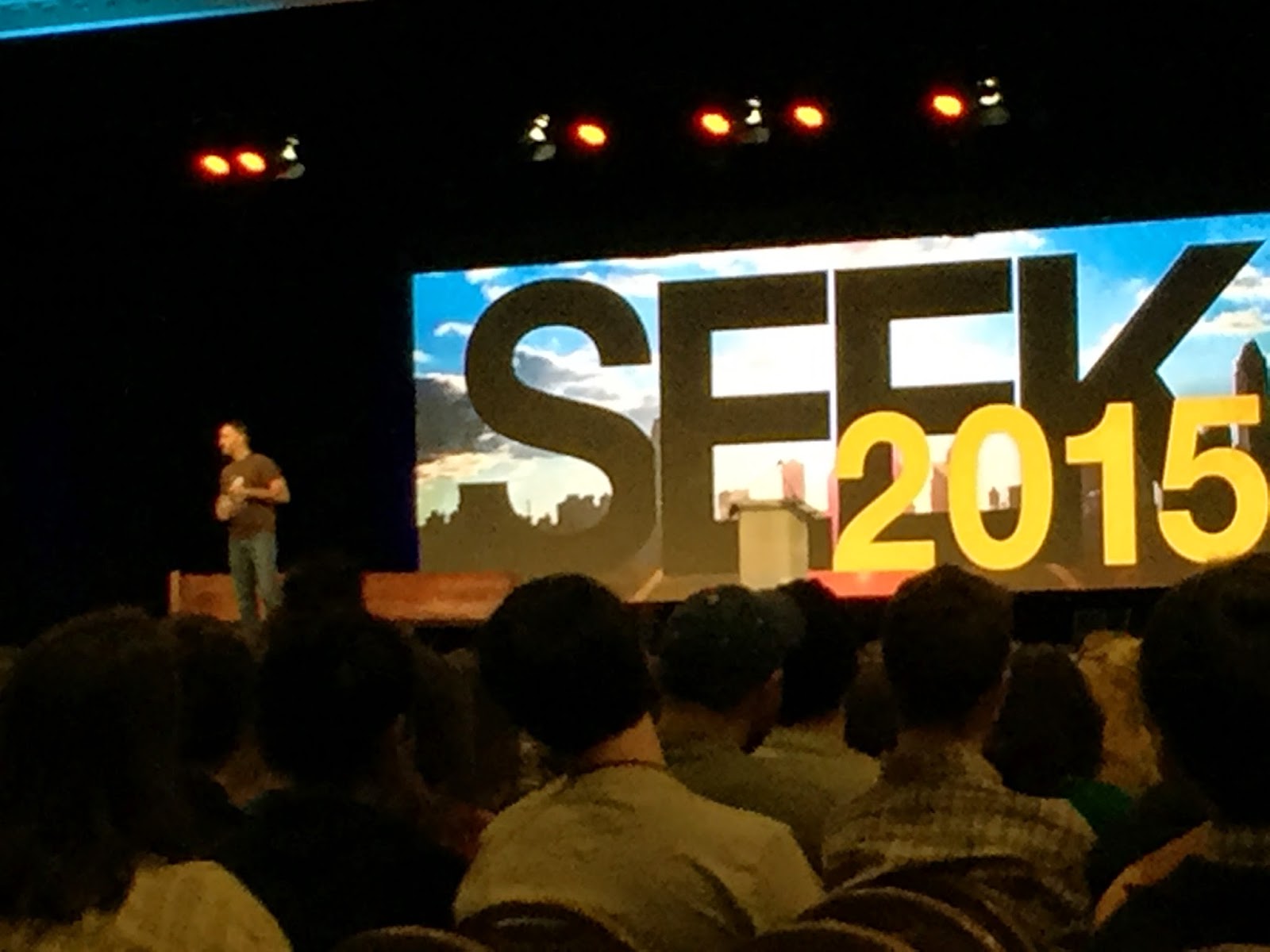
SEEK2015 and You Shall Find


As you’ve heard many times I’m sure, there are typically two ways of looking at things. You can focus on the bad news, or focus on the good news. If you focus on the bad news, it’s depressing. The path will be dark and full of injustice, leaving you most likely full of angst and perhaps a bit scattered in your vision of the world, and even of God’s governance of it. 

The second way of looking at things is to focus on the good news. Focus on the good (that where there’s life, there’s hope), and your path will be lighter and full of peace, leaving you rich in hope, compassionate, and unified in your vision of the world, and of God’s governance of it.

Now for a test of what your default perspective might be, picture nearly 10,000 college students, over winter break, in a luxurious five star hotel with all of the amenities, in the heart of a major city… for five days.


Bad news? Good news?

Read the rest here!

Thursday, January 08, 2015

God in the Nooks and Crannies


If one of the 12 labors of Hercules would have been to clean out our family minivan, the son of Zeus would have failed miserably. The Augean stables pale before the cumulative debris in our Honda Odyssey. The three-headed Cerberus he battled was a puppy before the monstrous mess our three kids, ages 6, 4, and 2 can make if given enough time, Crayola products, and cheesy puffs. How these little ones can accomplish the turning of sandwich bread, sugar-fruity loops, and french fries into atomized bits that somehow permeate and penetrate every crack and crevice of that van is beyond me. Once we get the great minds to work out how a two year old can get an intact potato chip under the sealed hard plastic infrastructure of a car seat, then I believe we can have teleportation figured out within months.

Children have a gift for getting into those places we thought impenetrable and inaccessible...

Read the rest here!


Wednesday, December 24, 2014

The Man, the Woman, and the Child

Nativity by Brian Kershisnik, Oil on canvas 
This mammoth oil on canvas called Nativity is the work of Brian Kershisnik, a resident of Provo, Utah. He is a husband, father, and an artist deeply inspired by the unseen world. When people learn he is an artist and ask him what he paints, Brian replies “I paint Heaven and Hell, and getting there.” Let’s allow our gaze to move over this work, and see just where it takes us.

There is a dynamic surge that dominates the scene; a rush of angels billows and breaks over the canvas like a foaming wave, grabbing our attention by the collar and nearly pulling us into its celestial current. I can imagine if you were standing in front of it (the canvas is 17 feet long and over 7 feet high!), you’d feel the need to brace yourself against being swept away in the resounding gloria about to burst from this multitude of heavenly messengers. Their expressions range from reverent wonder and incredulous delight to a passionate cry to the world to “come and see” what wonders God has done.

Read more here.

Monday, December 22, 2014

There and Back Again: A TOB Speaker's Tale

I had the incredible honor of traveling half way around the world to speak on St. John Paul II's Theology of the Body this autumn. As a devotee and teacher of the pope’s rich legacy of catechesis, an added grace for me was landing in a place that St. John Paul II graced three times in his own life; once as priest, twice as pope.

St. John Paul II in Papua New Guinea, c. 1985
I found myself in Papua New Guinea (PNG), a land that in some ways is as fresh and unspoiled as Eden. It has only felt the touch of modernism in the last 80 years or so. Grandparents of some of those I met actually recall seeing WWII bombers flying overhead and mistakingly thinking them to be giant birds! At the same time PNG is a land suffering from fallen humanity as much as any land, with greed, corruption, domestic violence and child abuse.

It's home to lush rain forests, beautiful coastlines and coral reefs, with over 800 dialects and hundreds of different tribal identities. But it is also a place where, in certain places, women and children suffer under a distorted idea of what masculinity means, and what marriage is meant to be. I spoke at the Kefamo Conference Center in the highland region of Goroka to nearly two dozen bishops who serve the Melanesian people. The bishops were wonderfully receptive, open and eager to share their thoughts as we moved through the days of reflection. A third of these men were native Melanesians, others were missionary bishops who ranged from afar as Germany, Italy, Canada, the USA and Australia. Some have served the people of PNG for over 40 years.

Frangipani blossom, which smelled heavenly

Dr. Adam Cooper of the John Paul II Institute in Melbourne, Australia, gave the first day of teaching on the background and history of the Theology of the Body as well as the reflection on "Original Man.” We had some very good conversations outside the classroom and I even had the chance to reconnect with him in Australia the following week at the John Paul II Institute. He was traveling with his wife Lizzie in PNG and we all enjoyed a love of the teaching as well as a sense of wonder at the flora and fauna of Papua New Guinea.

After the Coopers left PNG, I spent the next three days leading the bishops through the catechesis, finally closing with some words on the New Evangelization and the Way of Beauty in light of the Theology of the Body.

My final talk was attended by the Apostolic Nuncio of the region, Msgr. Michael Banach, himself a native of Massachusetts. He was very pleased that this content was being presented, and he shared during our closing session that indeed an emphasis on the "Way of Beauty" as revealed in St. John Paul II’s TOB catechesis is deeply important for the Church today. Fr.Victor Roche, SVD, General Secretary for the Catholic Bishops Conference of Papua New Guinea and the Solomon Islands was also very happy at the style of pedagogy, in which I employed source quotes from TOB and supplemental insights from Benedict XVI and Pope Francis’s Joy of the Gospel, as well as cultural examples, music, sacred art and some theological illustrations of my own. He said it elicited responses and sharing from the bishops which were refreshing and not always so common when it came to similar workshops he had arranged for them!

Fr. Victor has already indicated a desire to move forward in presenting the Theology of the Body at some level and through some medium that can allow the priests and people in general to come to know and live it. This sentiment was echoed by a number of the bishops as well (see attached evaluations supplied by Fr, Victor). We are presently discerning how to move forward given the challenges of time and distance.


Bishop Rochus Tatamai, grandnephew of Bl. Peter To Rot and Bill
As an aside, I had the privilege of meeting the grandnephew of Papua New Guinea’s first Blessed, Peter To Rot. His name is Bishop Rochus Tatamai, and he’s pictured to the right. He had asked if he could interview me for his radio station and actually pulled out a camcorder and proceeded to ask me questions on Theology of the Body for a solid 20 minutes! An amazing man of deep courage and faith.

The overall experience in PNG was humbling and hopeful. The struggles in this little nation of so much diversity are numerous. Polygamy, tribalism, the threat of secular modernism and a technological revolution without an adequate period of preparation for these simple people are tantamount. There is also, according to the bishops themselves, a disruption in the clergy’s understanding of what authentic celibacy is, so there’s all the more need for the Theology of the Body to shine in their catechesis and witness.


Bishops of PNG and the Solomon Islands, with Dr. Adam Cooper and Bill Donaghy
My second week abroad was spent in Sydney, Australia, where I gave a series of talks to young adults at Campion College, two Marionite churches, a talk at St. Mary’s Cathedral in Sydney, as well as a two day TOB seminar open to all at the Australian Catholic University (ACU). These events were largely orchestrated by one John Smyth, a Catholic school teacher who was phenomenal for making connections and queuing up my speaking events. He worked with Madeleine Vella, a former Generation Life missionary whose family hosted my stay the better part of that week.

Also in the mix for hosting and arranging things was Bernard Toutounji, Director of Catholic Youth Services. The two day TOB seminar at ACU was MC’d by him and sponsored by 14 different offices and ministries. He was instrumental in orchestrating it all.


Fr. Anthony Percy with Bill, Australian Catholic University.
During that week, I was privileged to meet Fr. Anthony Percy, priest and author of the wonderful book, Theology of the Body Made Simple. He’s a bit of a “celebrity” in Australia! I also met with Pat Langrell, one of our past students and now Chaplaincy Convenor at The University of Notre Dame, Melbourne. We sat down with some of the staff from the Archdiocese on connecting with the Theology of the Body Institute in the future. There was a strong desire from Pat Langrell, John Smyth, and Bernard Toutounji to potentially host a TOB1 week long course in Sydney as early as 2016.

At the end of the week, I took a short flight and one overnight in Melbourne, southern Australia, where I spoke on “Pope Francis and the Revolution of Tenderness” for a young adult ministry. I also met with Matthew MacDonald, Executive Officer of the Life, Marriage and Family Office and gave an extensive interview for the archdiocesan paper Kairos. That interview and an additional two articles can now be found online here in Volume 25, Issues 20 and 21

Bill's host family and friends, eating the best
Lebanese chicken in Sydney, and perhaps the world.
In Melbourne, I had the chance through John Smyth’s connections to meet up with Dr. Adam Cooper again in his office at the John Paul II Institute for Marriage and Family. I met Dr. Tracey Rowland and Dr. Gerard O’Shea briefly, then had a good chat with Dr. Adam Cooper and Dr. Conor Sweeney over coffee. We shared our work and experiences and touched on the importance of teaching the theology of the body and the need to bring it to the whole Church.

The Marriage and Family Office in Melbourne is equally excited about the potential of connecting with TOBI and our courses and they are willing to prepare the way for the Institute to offer programs when ready.


Overall, this was an incredible experience, and wonderful relationships have been forged, uniting people from distant places in the one Body of Christ, through the beautiful teaching on the theology of the body. I look forward to a return some day to both Papua New Guinea and Australia, but for now, after over 40 hours of plane travel in a dozen planes, and thousands of miles beneath me, nothing beat the reception of coming home!

“The new evangelization is inseparable from the Christian family.”
- Pope Benedict XVI

Talking to Your Little Ones About the Big Topic of Sex

A much repeated sentence we hear at our Theology of the Body retreats and courses is "I wish I heard this when I was younger!" ...