Saturday, September 23, 2006

Benedict XVI, Faith, Reason and Islam

For light and truth on such an important issue, I'm posting the following in full from Zenit.org:


ROME, SEPT. 23, 2006 (Zenit.org).- As the furor over Benedict XVI and Islam died down, people started to realize that the Pope was a victim of phrases taken out of context and reactions deliberately inflamed. In fact, this was what many Church officials and prelates were saying from the start.

Rather than being an attack on Islam, "What emerges clearly from the Holy Father's discourses is a warning, addressed to Western culture, to avoid 'the contempt for God and the cynicism that considers mockery of the sacred to be an exercise of freedom,'" noted Vatican spokesman Father Federico Lombardi on Sept. 14. The Jesuit explained that the Pope was criticizing modern culture for trying to exclude religion.

"A reason which is deaf to the divine," concluded the Pontiff in his Sept. 12 address at the University of Regensburg, "and which relegates religion to the realm of subcultures is incapable of entering into the dialogue of cultures."

Given this, the followers of an irreligious modern mentality had far more reason to be irritated with the Pope than anyone else, a fact that probably explains the extreme hostility of a New York Times editorial against the Holy Father published Sept. 16.

In a statement issued that same day, Vatican Secretary of State Cardinal Tarcisio Bertone pointed out that Benedict XVI in his Regensburg address was speaking to a group of academics and was simply using a text by Byzantine emperor Manuel II Paleologus, which the Pope made clear was not his own opinion. The quotation was a way to introduce a series of reflections. This approach was not understood by many in a media culture that relies on 5-second sound bites to convey messages.

For that reason, Cardinal Paul Poupard, president of the Pontifical Council for Interreligious Dialogue, recommended that people "read well" the Pope's text. Interviewed by the Italian daily Corriere della Sera on Sept. 15, the cardinal explained that if Muslims were to read and meditate on the text they would understand that, far from being an attack, it is rather "an outstretched hand." This is so because the Holy Father defended the value of religion for humanity, and Islam is one of the world's great religions.

Cardinal Camillo Ruini, the vicar of Rome, also insisted on the value of the Pope's discourse. His words came in the opening address Monday to a meeting of the Permanent Council of the Italian bishops' conference. A central point made by Pope during his trip to Bavaria, explained Cardinal Ruini, was that through faith in that God, man's reason and freedom find their higher and authentic fulfillment. In this context the Pope in his speech at Regensburg proposed a dialogue between cultures and religions -- a dialogue that is increasingly urgent.

Support for this dialogue also came from Bishop William Skylstad, president of the U.S. bishops' conference. "Given the circumstances of the last week," he said in a statement published Wednesday, "it is clear that dialogue is essential between Christians and Muslims, a dialogue in which we respect, in the words of the Holy Father, 'what is sacred for others.'"

Targeting the West

In an interview Sept. 17 with the Italian newspaper La Stampa, Cardinal Poupard commented that the Pontiff's main concern was not with Islam, but with Western culture. This was clear in Cardinal Joseph Ratzinger's warning against relativism just prior to the start of the conclave where he was elected Pope.

Backing up his point, Cardinal Poupard cited a part of a homily given by Benedict XVI in Munich on Sept. 10. The Pope had said: "People in Africa and Asia admire, indeed, the scientific and technical prowess of the West, but they are frightened by a form of rationality which totally excludes God from man's vision, as if this were the highest form of reason, and one to be taught to their cultures too.

"They do not see the real threat to their identity in the Christian faith, but in the contempt for God and the cynicism that considers mockery of the sacred to be an exercise of freedom and that holds up utility as the supreme criterion for the future of scientific research."

This aspect of the Pope's discourse was also highlighted last Monday by Cardinal Antonio Rouco Varela. Madrid's archbishop entered into the debate in a radio interview reported by the Internet service Análisis Digital the next day. The cardinal explained that the purpose of the Holy Father's speech was to examine the relationship between believing and knowing.

We need both faith and reason, Cardinal Rouco commented, and it is a mistake to conceive of a God who acts against reason. Far from being a sort of provocation directed at Muslims, the papal speech was a call for respectful dialogue between faith and reason, the cardinal said.

Manipulation

Concerning relations between Islam and the Catholic Church, Vatican Secretary of State Cardinal Bertone said he was confident that the explanations offered after the Pope's Regensburg speech would be accepted. Interviewed Monday by the Corriere della Sera, the secretary of state also complained about the heavy-handed manipulation of Benedict XVI's words.

Yet, he noted that the reaction to the papal speech from some Islamic leaders was favorable. For example, Mohand Alili, rector of the Mosque in Marseilles, France, had recommended against being offended by what the Pontiff said, as the speech was an invitation to meditate on the words of the prophet Mohammed. The problem, however, was that these and other positive reactions were not given media attention, Cardinal Bertone lamented.

>From Australia, Cardinal George Pell on Monday also criticized the way the Pope's words had been manipulated by some. In a press statement the cardinal expressed his gratitude for the words of moderate Muslims.

Days earlier, on Sept. 13, the archbishop of Sydney spoke about the theme of dialogue between the West and Islam, in the aftermath of the Pope's address in Regensburg. Addressing the Union Club in Sydney, he noted that the great religions differ significantly in doctrine and in the societies they produce. And while religions can be sources of beauty and goodness, they can also fall into corruption and be sources of poison and destruction, the cardinal cautioned.

But for those who see religion as a source of violence, Cardinal Pell pointed out that "The worst evils of the 20th century were provoked by anti-religious men: Hitler, Stalin, Mao and Pol Pot."

In an interview published Monday by Spiegel Online, Cardinal Walter Kasper, president of the Pontifical Council for Promoting Christian Unity, noted that conflicts with Islam are a part of Europe's history, which was what the Pope was referring to in his address.

But there is an alternative to conflict -- dialogue -- which is what the Pope favors. This dialogue is not easy, the cardinal acknowledged, as it is difficult under the current circumstances "to find representative counterparts to talk with."

We should not approach this dialogue naively, continued Cardinal Kasper, since there are major differences between Christian and Islamic cultures. In fact, the policy of multiculturalism favored by European countries has not worked in relations with Muslim communities.

"The fundamental issue, when it comes to Europe's future, will be whether and how we manage to transfer the ideals that once made Europe great -- especially its Christian roots -- into today's changed world," concluded the cardinal. Not an easy task, judging by Regensburg.
ZE06092302

+

Sent from my BlackBerry® wireless handheld

Thursday, September 21, 2006

Smelling September

I don't know where you are, reading this right now. But right now, in southeastern Pennsylvania, USA, the leaves are beginning to lose their grip, the wind is breathing cooler, and the earth smells soooo good. We have a cycle of seasons; they rise and fall from spring to winter like the very lives we live. And every season is a chance for us to taste again the sweetness and the sorrow, to pass through ourselves a life in miniature; to hear again that "still sad music of humanity." From the green fire of a youthful spring, to the ripe joys of summer, and into the contemplative colors of fall... we prepare ourselves for the quiet sleep of winter. I love the fall most of all. The very air has such a richness to it; the leaves are burning in a last shout of glory, and their earthy incense is a melancholic fragrance. It draws us into our past. The burnt gold of the evening horizon, the red-rimmed maple trees, the barren branches with their hundred tiny fingers, stretching out into space, stark against a deep night sky. For me, there is something ancient in this season, something somber. And yet pointing towards a promise, even through the cloak of brown leaves and misty mornings. Tomorrow, I'll begin again a journey through my favorite book, Tolkien's Lord of the Rings. That journey begins in the autumn of Middle-Earth, a season and a place that Tolkien says is our own, just deeper into the pages of history than can be remembered. The time is a sad one; the Elves are moving through the Old Forest. And with them something of the magic of the world, the ancient ways, the high poetry is leaving too. They are moving towards the Grey Havens, singing hymns of Elbereth and Earendil, leaving Middle-Earth forever. As I sit on the shores of this new millennium, just beginning, and look back at the 20th century and so many gone before it, I see much that once was has been forgotten. In our noise and haste, lessons are left unread and unlearned. In my own life, and the cycle of its seasons, how many times have I forgotten the wisdom that came through the Woods. Through the leaves that rustled with Truth, the Beauty that came to me in every Sun rising. But what lies ahead is the journey. For the Elves, and for the Fellowship of the Ring as they begin their heroic walk, the journey is one of hope. A hope "beyond all memory." A hope that what is evil in the world can finally be overcome. A hope that Good can prevail, and the ancient wisdom, the Music that made the world can be played in all it's fullness. Let the journey begin! + Bill Donaghy www.missionmoment.org

Sunday, September 17, 2006

Beautiful reflection from today's Magnificat entry by a Spanish priest, Fr. Carron. Thought I'd share the WHOLE THING... below: "Who do you say that I am?" "Unless each of us is fascinated by Christ, it is impossible for nothingness not to prevail even in us. We have not solved the problem; the drama goes on living in each one of us. The struggle is fought out in our hearts every day, in the personal, mysterious dialogue between the "I" of each of us and the fascination that is Christ. Without the victory of this fascination, we are finished... We reduce reality to appearances and so we live a relationship with reality that has done away with the Mystery, the "Something that is within every something." We can all see how true this is by simply asking ourselves what happened this morning. How many of us, as we looked at reality today, said, "You" to the Mystery that makes reality and that makes the "I" that woke up this morning? Who was moved with gratitude this morning because he is there, because the Mystery is there, because my "I" with all its limitations is already embraced by his presence?... That is why the Mystery appeared in history: to set before our eyes an attraction strong enough to draw along our "I." Otherwise, we are like a drifting mine, and everyone does just what he likes - not out of malice, but because we are not the ones to attach ourselves with our own strength; it is only this attraction that brings out a deep liking for Jesus in me. Once you have sensed this, you cannot fail to discover the need for his presence in anything you live (I am the One you are missing)." - Father Julian Carron

Friday, September 15, 2006

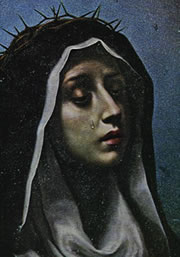
A Mother Standing At the cross her station keeping, Stood the mournful Mother weeping, Close to Jesus to the last. Through her heart, His sorrow sharing, All His bitter anguish bearing, Now at length the sword had pass'd. These are the first two stanzas of the "Stabat Mater," a powerful hymn written in the Middle Ages and sung in a mournful chant on today's Feast, Our Lady of Sorrows. It reflects upon the suffering of Mary as she stood by the Cross of her Son. The Latin phrase stabat mater means "mother standing." In the wake of the awful anniversary of 9/11 and countless other global tragedies, today brings before our eyes the place of ultimate suffering; Golgotha, Calvary, the Cross. Here, Love itself was crucified. But at that very place where we so often fear to go, or are tempted to flee, the place of suffering, pain, and injustice, a Mother is standing. I think about the many images taken from recent news stories, where the young are slain through meaningless acts of violence, or natural disasters strike, taking little ones away. I think of the strength of mothers. Strong for their families, for their young ones. But in this awful place of suffering, what do we do? When tragedy falls upon us, like structures of steel and stone, and we feel we cannot bear them, what is our position? So often we ask the question "Where was God?" Where was He in my pain? Why did it come to me at all, or to those innocent little ones? In the gap left by that question of questions, "Where was God?"... a Mother stands. At the contradicting crossroads, where life and death meet, in the tension of that suffering that wants us to give up or give in, to despair or to hope, a Mother stands. I heard it said once that suffering is "continued receptivity before God." Mary was and is the star of our race because she was always receptive to God. Therefore, she always suffered. She always knew there would be the Cross. She lived in its shadow. She stood in that contradiction; she lived in that mystery of mysteries. The legacy of sin, suffering, and death were hers by choice, not by nature. She laid down her life by standing with Jesus. How can this be done, humanly speaking? The secret, I believe, is trust. How do we live through the great stripping of our humanity, the loss of dreams, the fires of sorrow? Trust. For us, trust in that we are not alone. A Mother stands by, who stood there by that dear rugged Cross "where the dear Savior gave His all." There is something in this woman, and I believe in the heart of every woman because of her, that enables them to stand in the gap of sorrow. It's the feminine genius; the receptive heart, the womb of contemplation that can hold life and death in its tension of opposites, and trust. It is the waiting heart, that waits for man. That watches him and waits for him, that allows him to make the gift of himself, to be the victim, to take the bullet, battle the dragon, perhaps even die in doing so. Mary is our model, not because of a pious sweetness, a gilded glory surrounded by chubby angels, but because of her rugged, weary, wind-swept stand at the Door of Death, and her faith that held the courage to look beyond it. Our Lady of Sorrows, pray for us...

Thursday, September 14, 2006

The Problem of Evil Ever since the first sin of dis-obedience at the dawn of creation, there has been dis-integration in the world. Di-vision, dis-order, de-struction, and di-abolical designs are all around us, and within us. Don't you feel it?

Suffering and Death aren't merely theological ideas for scholars to ponder. The wounds are in you and me. The definitions of these Two Towers of human experience are written in our flesh and bones. Why must it be this way? Why do we fight and grasp and tear at each other? Why do bad people seem to succeed and the good suffer unjustly? Deeper still is the question "Why is there suffering at all? Why is there evil?" And why is it distinctly a human thing to ask why? There are no books on coping with tragedy in the animal kingdom. Zebras don't ponder the problem of evil.

If we are just bipedal fleshy parts of this creation, like super-apes, then why do we sigh for vindication and justice? Deeper still for immortality, for Something More? If evolution says it isn't broken, then why are we trying to fix it?

We write poetry, love songs and hymns. We ache for an Unending Love. But the other creatures in this world don't write love songs. Chickens don't weep at Mozart's Requiem. But we do. We see the division in the world. We see evil battling good, clawing after it in with an infernal jealousy. And we know there must be a reason; there must be More. There must be a Healing. There must be a Re-Union.

How could this desire exist in us if there were not a way to fulfill it? Thirst pants for water, hunger finds food. If our hearts yearn for a Fullness of Truth, Beauty and Goodness found only in fragments here, then....

I think in some ways the problem of evil, and the tear caused by suffering and death, is actually more a proof for God's existence than it is a reason not to believe in Him. I want peace, healing, wholeness. I want vindication, justice, the victory of Truth. I want redemption but I can't get it. If I can't then who can? And if this frustration and defeat is all there is, then why do I hope for more?

The words from an Alison Krauss song come softly like a healing balm:

"Love that shed His Blood for all the world to see, this must be the reason for it all."

Jesus Christ fully reveals man to himself and makes his supreme calling clear (Gaudium et Spes, 22). All of the contradictions in this world and in our lives meet at the Crossroads. Suffering and Death have come to us, through the dis-obedience of our ancestry. And if we are honest, that apple doesn't fall far from the tree. Its repercussions are rippling throughout all time and space. We suffer for it, the young and old, the good and bad. But we are not alone. He has taken on our sorrows. He was crushed for our offenses, bruised for our evils... Suffering and Death are not our lot alone anymore, like a card we can trump God with. He suffered too; in fact, He became suffering. He swallowed death. And even now the Universe is being remade in Him. All creation groans. The labor pains have already begun. The seed that has fallen to the earth in death, in me and around me, is already breaking earth, and will blossom into New Life. We believe, Lord. Help our unbelief.

Tuesday, September 12, 2006

Echos of the One I have learned more from the shine in a dewdrop on the petal of a wildflower than from man and all his theories his grasping after power I have read more in the falling leaves That tumble, wilt, and bear new life Than ever in the pages of man scratched in haste and full of strife I have listened in the cool night's breath To symphonies more grand Than orchestras assembled fair For the feeble notes of man But through the words and wood and paint though cracked and frail they be I see with trembling fingers a trace of eternity We frame with fallen hands the echo of the One we reach to catch in song and stone the Heart of our True Home And though it's but an icon a shadow before the sun I'll write and shape and sing as well my echos of the One

Monday, September 11, 2006

As Fall Returns and Nature Sings

Here's one of my favorite poems from William Wordsworth:

The world is too much with us; late and soon,
Getting and spending, we lay waste our powers;
Little we see in Nature that is ours;
We have given our hearts away, a sordid boon!
This Sea that bares her bosom to the moon,
The winds that will be howling at all hours,
And are up-gathered now like sleeping flowers,
For this, for everything, we are out of tune;
It moves us not. -Great God! I'd rather be
A Pagan suckled in a creed outworn;
So might I, standing on this pleasant lea,
Have glimpses that would make me less forlorn;
Have sight of Proteus rising from the sea;
Or hear old Triton blow his wreathed horn.

- William Wordsworth

+

Sent from my BlackBerry® wireless handheld

Talking to Your Little Ones About the Big Topic of Sex

A much repeated sentence we hear at our Theology of the Body retreats and courses is "I wish I heard this when I was younger!" ...